

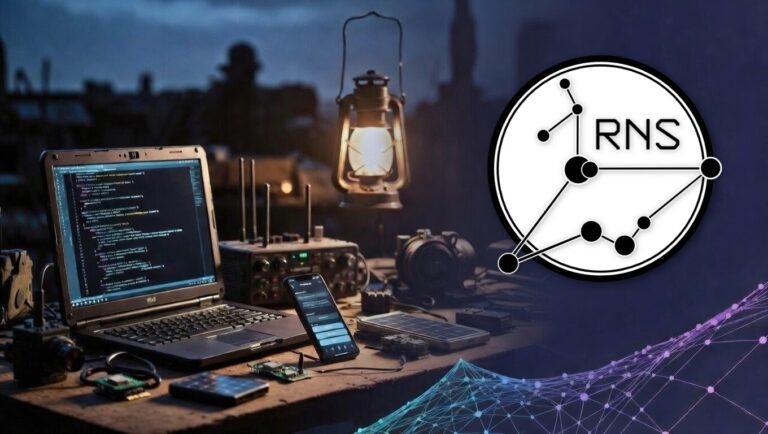
In a world where Big Tech and governments gatekeep communication, censoring dissent or throttling non-compliant users, decentralized protocols like Reticulum Network Stack (RNS) offer a lifeline.
Imagine ditching TCP/IP’s leaky encryption and centralized servers for a protocol that runs natively over inexpensive radio hardware, forming peer-to-peer meshes no one can shut down.
Presented in this eye-opening YouTube presentation, RNS empowers “networks for the people, by the people.”
What is Reticulum (RNS)?
RNS isn’t a band-aid on IP—it’s a fresh networking stack using cryptography for addressing, routing, and encryption. Key perks:
- Mandatory end-to-end encryption: No config slips expose your data; unencrypted packets get dropped.
- Initiator anonymity: Senders stay hidden unless they choose otherwise.
- Self-configuring meshes: Links up heterogeneous radios, Ethernet, LoRa, even Morse code at 5+ bits/second.
- Global, self-sovereign addresses: Derived from Ed25519 keys with no DNS gatekeepers or IP handouts needed.
Unlike TCP/IP, where your local chat bounces through overseas servers you don’t control, RNS routes directly peer-to-peer or via efficient hops. It thrives on low-bandwidth setups, perfect for disaster zones, censorship blackouts, or rural off-grid life.
Running RNS Over Inexpensive Radio Networks
Grab cheap gear like LoRa modules (e.g., ESP32 boards under $20), packet radio modems, or VHF rigs. RNS interfaces plug in effortlessly with no subnets or IP fiddling. Example setup:
- Flash RNS on a Raspberry Pi or ESP32.
- Attach a LoRa radio (e.g., SX1276 for long-range, low-power).
- Announce your crypto-address; the mesh auto-routes to others.
This forms independent radio networks resilient to internet kill-switches. Demos show real-time audio calls over LoRa using Codec 2, file shares, and telemetry and all at 300-1200 baud. Bridge to WiFi for hybrid use, or go pure radio for true sovereignty.
Real-World Apps from the Video
The talk demos battle-tested tools (MIT-licensed at rns.network):
- LXMF messaging: Sovereign chat with Sideband (text/voice/files/bots) or MeshChat (audio calls). Roams seamlessly from phone WiFi to mountain LoRa.
- Nomad Network: Host dynamic pages with forums, news, or even Wikipedia mirrors.
- Utilities: RSD router, interactive shells (like SSH over radio), file drops/servers, ping-like tools.
These run on constrained hardware, scaling to 100k+ nodes per device.
Links to Broader Mesh Tech
RNS pairs with:
- Meshtastic: LoRa meshes for off-grid text/position sharing allowing adaptive RNS for encrypted overlays.
- MeshCore (related dev work): Core for radio meshes.
- Emerging RNS apps: Check Reticulum GitHub for LXMF bots, telemetry, remote control.
Why It Matters for Decentralized Freedom
As comms get “gated off to the masses who don’t comply,” RNS lets free people build private networks. No server owners yanking your “action potential.” Organic growth: Isolated ham radio links converge into city-scale meshes automatically. In unethical mandate scenarios, share knowledge, coordinate, stay anonymous, and achievable over $10 radios.
Get started: Reticulum docs. Join the Critical Decentralization cluster for hands-on.
OffLib.org: Tools for the ungovernable.